

In Kyoto, time seems to move differently. The city invites visitors not simply to see its beauty, but to inhabit it — to step into rituals that have shaped Japanese culture for centuries. Beyond the iconic temples and lantern-lit streets lies a quieter, more intimate experience: the tea ceremony. Here, tradition is not performed for display, but lived through gesture, discipline, and presence.

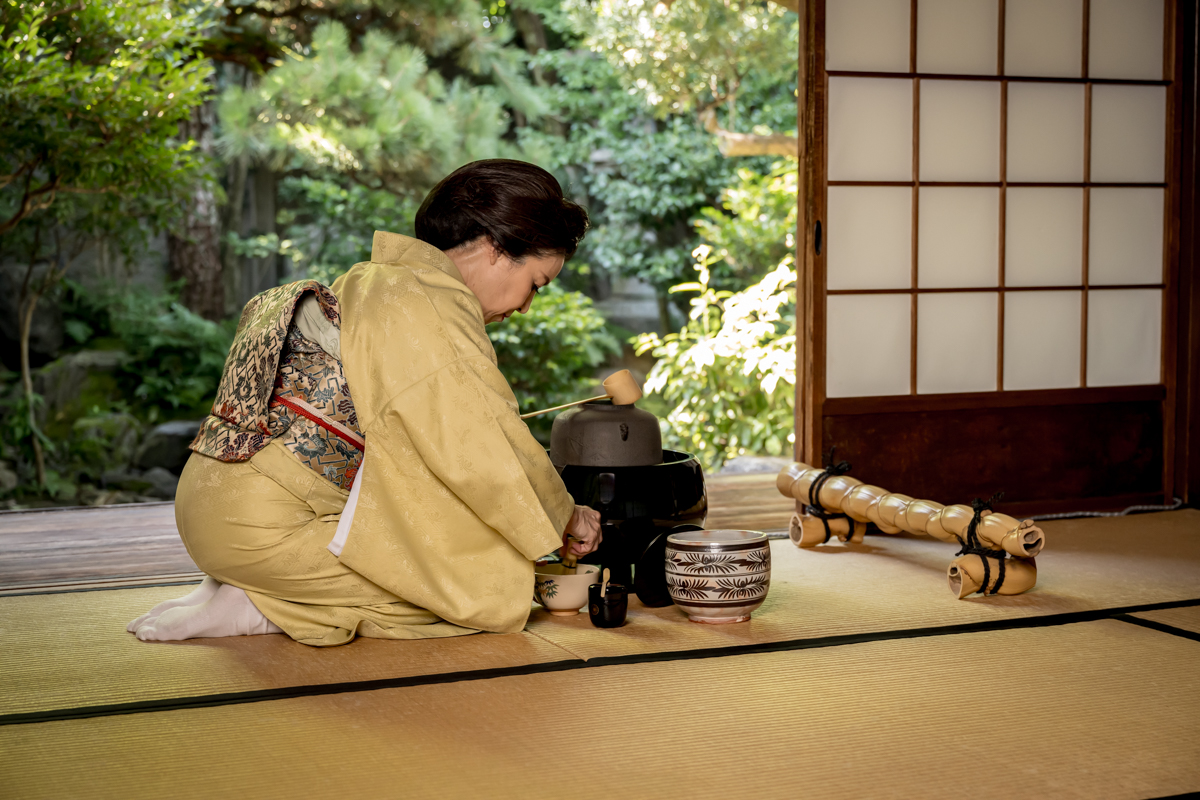
During Porterium Magazine’s visit to Kimono Tea Ceremony MAIKOYA in Kyoto, we met Yukiko Miyazaki, whose calm grace and deep knowledge reflect the enduring spirit of this practice. Dressed in kimono, guests are gently guided into a space where every detail — from the arrangement of flowers to the placement of utensils — carries meaning. Rooted in the philosophy of Sen no Rikyu, the ceremony reveals itself not as a performance, but as a shared moment of mindfulness between host and guest.

What follows is a conversation that illuminates the ceremony’s relevance today, its quiet teachings, and the misconceptions that often surround it. Through Yukiko Miyazaki’s reflections, the tea ceremony emerges as something profoundly human: an exchange of care, attention, and respect that transcends language and time.
How would you describe the core philosophy of the Japanese tea ceremony to someone experiencing it for the first time?

The tea ceremony is not something that can be done alone. There is a phrase, ichiza konryu, which means creating a meaningful gathering together in one shared space. A tea gathering becomes truly special when both the host and the guests act with consideration and sincerity toward one another.

The host carefully prepares everything, including the hanging scroll, flowers, utensils, matcha, and sweets, and offers tea with wholehearted hospitality. I believe this spirit of thoughtful preparation and genuine care is at the heart of the tea ceremony.
For the guests, appreciating the space, the host’s movements, and the tea and sweets being served helps make that particular meeting, ichigo ichie, a once-in-a-lifetime encounter, meaningful. For those experiencing it for the first time, I hope they will simply participate with curiosity and enjoy each element with an open heart.
What aspects of the tea ceremony are most important to preserve for future generations?

I believe it is important to preserve both the teachings passed down from our predecessors and the physical spaces and utensils associated with tea.
For example, there are guiding principles such as the Seven Rules of Rikyu, which express the mindset of tea:
• Prepare tea so that it is delicious.
• Place the charcoal so that the water boils properly.
• Create coolness in summer and warmth in winter.
• Arrange flowers as they grow naturally in the field.
• Be punctual and respect time.
• Be prepared even if it does not rain.
• Be considerate of your fellow guests.
These teachings emphasize sincerity, preparation, seasonal awareness, and consideration for others.
As for tea rooms and utensils, while tea can technically be prepared anywhere, making tea casually in a kitchen is very different from preparing it in a fully arranged tea room where every element, from the alcove to the utensils, is thoughtfully prepared and movements are performed with care.
In modern life, traditional tea rooms and the craftspeople who create tea utensils are gradually disappearing. I believe it is important to consciously protect and support them before they are lost.
Can you explain the significance of the rituals and etiquette practiced during the ceremony beyond simply serving and drinking tea?

During the preparation of tea, the host performs acts of purification. In front of the guests, the utensils are carefully cleansed so that the tea may be served in a pure and respectful manner.
The host’s movements are not only practical but also calm and beautiful. Through these gestures, it is not only the utensils that are purified, but also the hearts of the host and the guests.
Guests also express consideration through their behavior. As Rikyu taught, one should be mindful of fellow guests. Because there are moments of silence during the ceremony, feelings of respect and care are often communicated not through words, but through gestures. The etiquette becomes a quiet language of thoughtfulness.
How does this tradition connect to principles such as harmony, respect, purity, and tranquility, known as wa, kei, sei, jaku?

Zen philosophy cannot be summarized in just one sentence, but in Zen practice one trains to regulate body, breath, and mind.
In tea practice, we repeat the same movements again and again, continuing our training until we can move naturally and calmly. Through this repetition, we learn to steady our breath and settle our mind.

At the same time, we become aware of the space, the utensils, and the people present, adjusting ourselves so that everything comes into harmony. In the quiet atmosphere of the tea room, we reflect on ourselves and also pay attention to the person in front of us. I believe this quiet awareness is one of the connections between Zen and tea.
For reference, wa, kei, sei, jaku are not originally Zen words, but expressions of the spirit of wabi-cha as articulated by Sen no Rikyu.
What are some common misconceptions visitors have about the tea ceremony before experiencing it?

Many people imagine that the tea ceremony is intimidating, extremely strict, or only for certain types of people. Some also assume it is exclusively for men or exclusively for women.
Historically, tea culture was associated with Zen monks and samurai. However, today both men and women practice tea.

It is true that there are many rules, and it is not simple. However, I hope visitors do not see it as something impossibly difficult. Rather, I hope they experience it as an opportunity to learn about the traditional Japanese spirit of hospitality and the manners expected of a guest. It is a place where one can learn sincerely while also enjoying the experience.

As our time at MAIKOYA came to a close, the experience lingered not as a memory of an activity, but as a shift in perspective. The tea ceremony does not seek to impress; it invites one to slow down, to notice, and to participate in a form of hospitality shaped by centuries of intention. In a world that moves relentlessly forward, this quiet ritual offers something rare — a space where presence becomes the true luxury.

For Porterium Magazine, the kimono tea ceremony at MAIKOYA stands as one of Kyoto’s most meaningful cultural encounters. It is not defined by spectacle, but by intimacy; not by performance, but by sincerity. Within the stillness of the tea room, past and present meet, reminding us that the most enduring traditions are those that continue to be felt, shared, and lived.

Leave a Reply